
Damp and mould your landlord won't fix?
Get the repairs done and claim the compensation you may be owed. It starts with one call.
If you have damp and mould in your home, your landlord must put it right by law. If you rent social housing in England, Awaab's Law applies. Once you report it, your landlord must act within 10 working days. How much you could claim depends on how long it lasted, how serious it was, and any effect on your health. There is no fixed timescale, though months rather than days is realistic. No upfront cost. You only pay if you win, and the fee comes out of the compensation, not your pocket. If you don't win, you pay nothing.
England: Section 11, Landlord and Tenant Act 1985 + Homes (Fitness for Human Habitation) Act 2018. Wales: Renting Homes (Wales) Act 2016 repair and fitness duties.
Drag to see what our inspector records
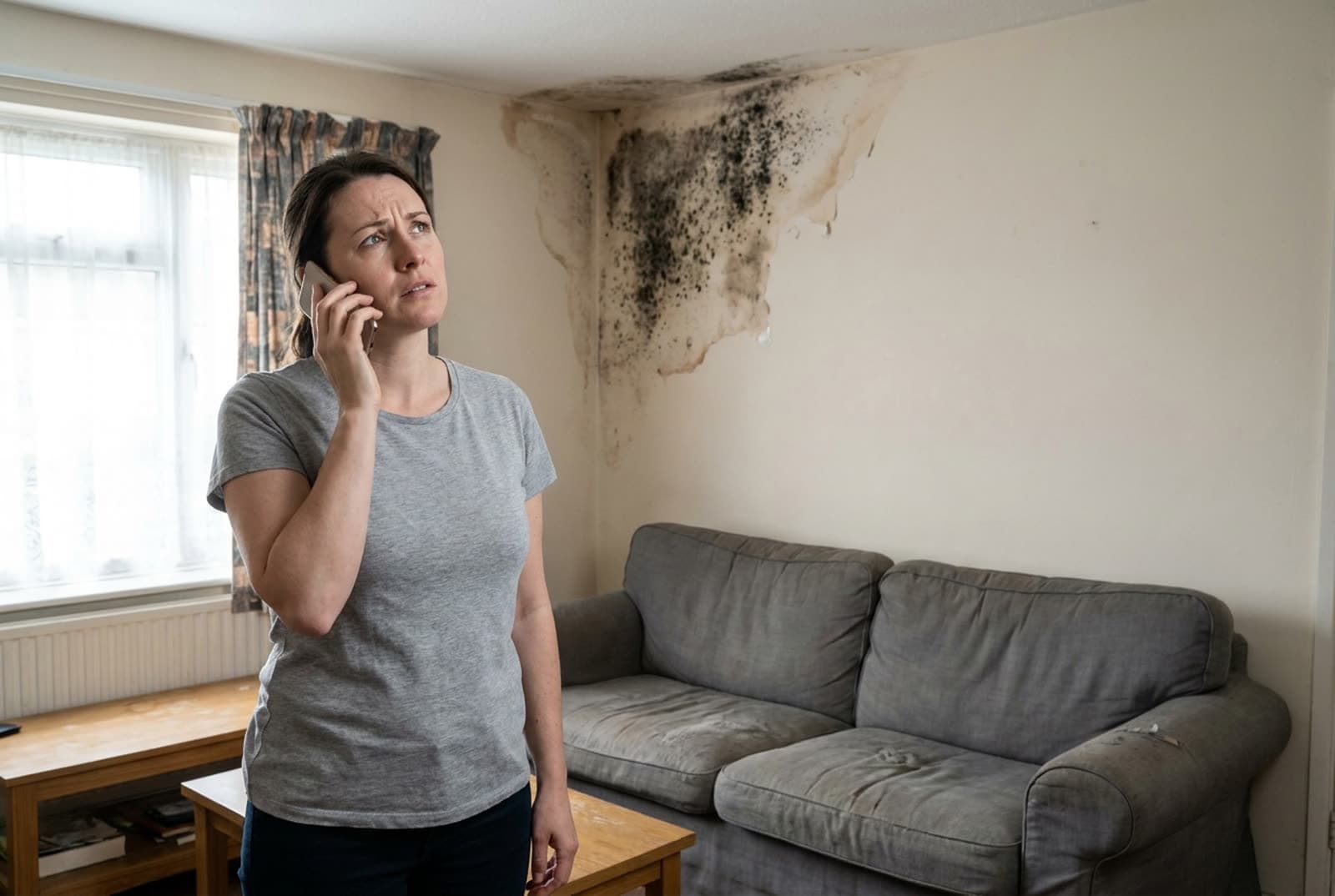
The same photo, two ways of seeing it. What you live with every day is, to a surveyor, a list of defects your landlord must put right.
An independent inspection records every defect like this, with photographs, as evidence for your claim. There is no cost to you for the inspection.
Symptoms
- Black spots on walls, ceilings, or window frames
- A musty smell that doesn't go away
- Peeling wallpaper, paint, or blown plaster
- Damp staining or tide marks on walls
- Condensation that builds up daily
- Mould on clothes, shoes, or furniture
- Recurring chest infections or asthma flare-ups
Health impact
- Respiratory infections (linked to Awaab Ishak's death, December 2020)
- Asthma triggers, particularly dangerous for children under 12
- Allergic rhinitis, sinus problems
- Worsened eczema and skin conditions
Evidence to gather
- Photograph every mould patch with a date-stamped phone camera (settings → camera → 'date stamp' on)
- Keep every email, letter, and text message you've sent to your landlord, even WhatsApp screenshots count
- Ask your doctor for a written note linking your symptoms to home conditions
Evidence
How to photograph the problem
Good photos make your case stronger. A surveyor or solicitor needs to see where the problem is, how bad it is, and when you took the photo.
- Wide shot: shows which room and wallStand in the doorway and photograph the whole wall, so it is clear where in your home the problem is.
- Close-up: shows what the problem isGet near enough that the damage fills the frame and is in focus.
- Include something for scaleA hand, a coin or a ruler in the frame shows how big the problem really is.
- The date on your phone is your recordKeep the original photo on your phone. Its saved date is a record of when you took it.
If something looks dangerous, like bare wires or a bulging ceiling, do not get close. Photograph it from the doorway and report it straight away.
Get your evidence ready
You do not need everything on this list to call us.
Dated photos of each problemPhotos on your phone keep the date they were taken.
Your doctor's note if health was affectedA short letter linking symptoms to the home helps.
A wider photo of each affected roomShows where the problem is in your home.
Your written reports to the landlordEmails, portal messages or letters, with their dates.
The landlord's repliesWhat they said, and when, or the silence itself.
Dates of phone callsA simple note of when you called and what was said.
Receipts for anything ruinedClothes, bedding, furniture or extra heating costs.
Your tenancy agreementConfirms who your landlord is and when you moved in.
A note of when the problem startedThe clock starts when your landlord knew about it.
Ticks are saved only on this device.
Another route: Environmental Protection Act, Section 82
Section 82 of the Environmental Protection Act 1990 can run alongside a Section 11 disrepair claim. 21 days written notice, then a Magistrates' Court hearing. Faster than civil court for active nuisances.
Read about the EPA Section 82 routeFrequently asked questions
How much money can I claim for damp and mould?
How much you could get depends on how bad it is, how long it went on, and how it affected your health, so we cannot promise a figure. No upfront cost. You only pay if you win, and the fee comes out of the compensation, not your pocket. If you don't win, you pay nothing.
How long does a damp and mould claim take?
There is no fixed time. Months rather than days is realistic, and it depends on your evidence, how your landlord responds, and how complex the problem is. If you rent social housing in England, Awaab's Law (Section 10A LTA 1985, started 27 October 2025) gives your landlord 10 working days to act. Wales uses the Renting Homes (Wales) Act 2016 instead.
What proof do I need for damp and mould?
Photos and videos with the date on them. A note of when you told your landlord and what they said. A letter from your doctor if anyone has been ill.
Can I claim if I owe rent?
Yes. Owing rent does not stop you making a disrepair claim. They are separate things in law. We will talk through your situation honestly.
How do I get rid of damp and mould on my walls?
You can wipe a small patch off with mould spray and keep the room aired. But that only treats the surface. If the damp and mould keep coming back, something is causing it. That could be a leak, rising damp, or not enough ventilation. Fixing the cause is your landlord's job, not yours. Report it to them in writing so the Awaab's Law deadlines start.
Is black mould in the bedroom or bathroom dangerous?
Black mould can affect your breathing and is a real risk for children, older people, and anyone with asthma or a chest condition. If there is black mould in your bedroom or bathroom, your landlord must treat it as a serious hazard. Keep a note of any coughing, wheezing, or doctor visits.
Why is my flat damp, and what should my landlord do about it?
Damp usually comes from a leak, a roof or guttering fault, rising damp, or poor ventilation. Your landlord has to find the real cause and fix it, not just paint over it. Is your landlord a council or housing association? Then Awaab's Law gives them 10 working days to investigate serious damp. They then have 5 working days to complete the safety work after the investigation ends. The government intends to extend these deadlines to private landlords, on a timetable it is still confirming.
Read more about damp and mould
Put it in writing
A written record helps your case. Copy a free, plain-English template, fill in the brackets, and send it to your landlord.
Related
Damp and mould at your landlord
Repair deadlines and your rights for damp and mould with these social landlords.
Damp and mould where you live
Your rights for damp and mould in these areas.
This is worth a claim
Published decisions show what landlords were made to pay tenants across England in one recent year. A panel solicitor can advise what may be recoverable for damp and mould in an individual claim.
- £5.4m
- compensation ordered for tenants in one year
- 26,901
- orders and recommendations made
- 578
- cases had orders over £2,000
- Almost £32,000
- the largest single order
Figures from the independent statutory review, Annual Complaints Review 2024 to 2025. These are sector-wide outcomes for social housing tenants in England.
Read deeper, Damp and mould
Practical Q&As, legal context, and named case studies on this topic. Every link below is a Support for Tenants page.
By: Support for Tenants editorial team
Last updated:
Reviewed against current housing law for England and Wales as at 15 June 2026. Checked by our SRA-regulated panel solicitors. This is general information, not legal advice for your specific case. Any compensation figures or ranges shown are illustrative only, not a promise; every case is different.