Penetrating damp, rising damp, condensation, black mould, they're caused by different things and your landlord's duties differ. Plain-English guide.
On this page
"Damp" and "mould" get used as if they were one thing. They are not, and the landlord's legal position shifts with which one you have.
This is not pedantry. Naming the issue right in a complaint letter strengthens the case.
What is damp?
Damp is moisture in the walls, floor or ceiling. Three main causes exist, each with its own fix.
Penetrating damp
Water getting in from outside: a cracked wall, a broken roof tile, a blocked gutter, a leaking pipe, failed rendering.
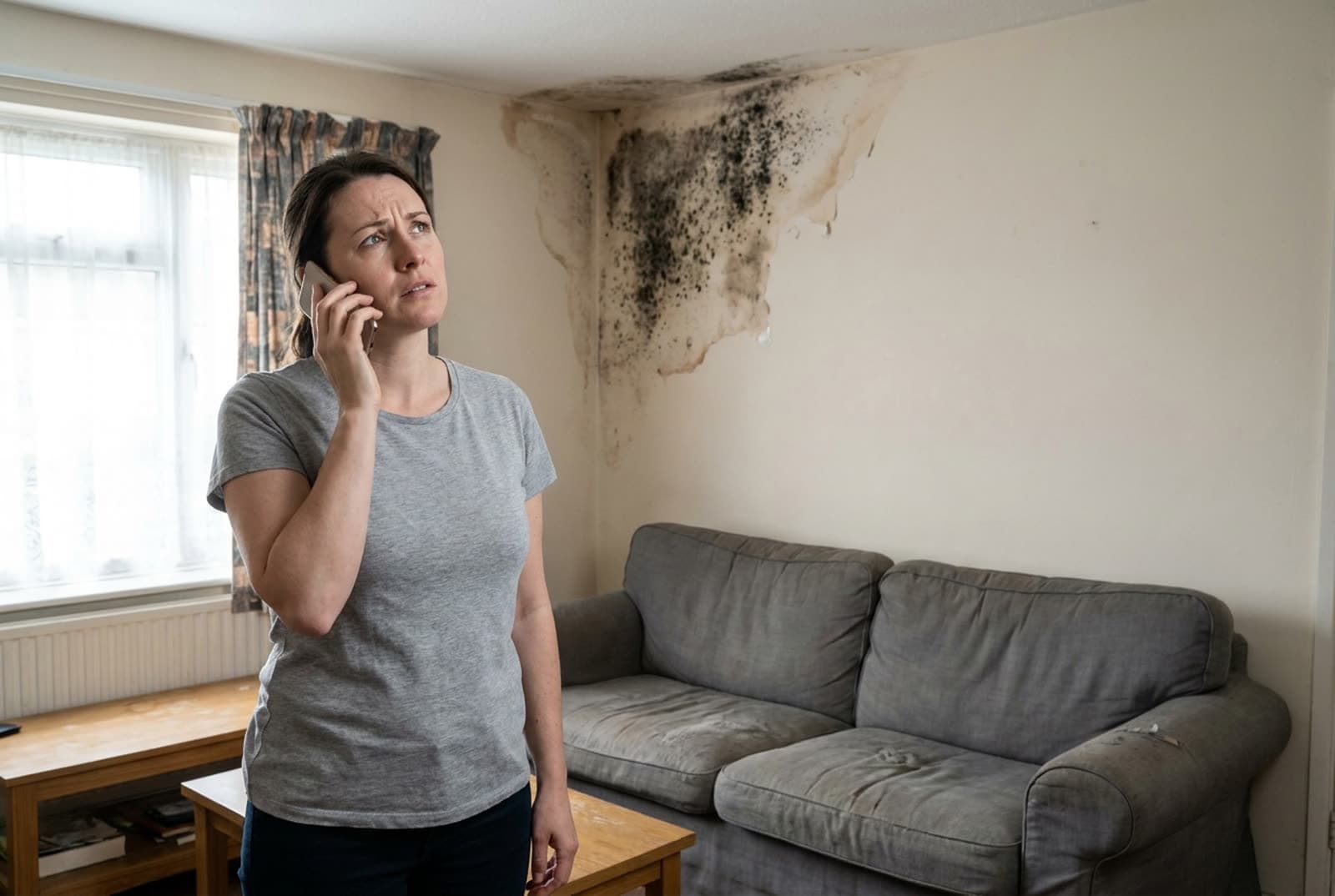
It shows as tide-marks, patches that never dry, or bubbling paint and plaster. The wall runs cold to the touch and can smell musty.
Cause: a structural defect or building failure. Landlord's duty: investigate, find the source, fix the cause. Not just patch the symptom.
Rising damp
Moisture climbing from the ground through brick or stone. It usually shows as a tide-mark up to 1 to 1.5 metres above the floor, with white salt deposits.
Cause: a failed damp-proof course (DPC), which most homes built after 1875 should have.
Landlord's duty: install or repair the DPC. A real works job, not a paintbrush one.
Condensation damp
A different cause: warm, humid air meeting cold surfaces. Showers, cooking, drying clothes indoors, even breathing all load the air with moisture. Hitting a cold wall or window, the water condenses out and runs or pools.
It runs worst in bathrooms, kitchens and bedrooms with cold outside walls, showing around windows, in corners, behind furniture.
Cause: usually a mix of poor ventilation, poor insulation, and moisture-heavy habits like drying clothes indoors.
Landlord's duty: proper ventilation, working extractor fans, vents, windows that open, and proper insulation. "You should ventilate more" defeats no claim where the design never allowed proper ventilation in the first place: that IS the landlord's responsibility.
What is mould?
Mould is a fungus growing on damp surfaces. The most famous is Stachybotrys chartarum, black mould, though white, green and yellow kinds exist.
Mould needs damp to grow: mould means damp, always. Bleaching or painting it without fixing the damp brings it back within weeks.
The health risks
Here is where Awaab Ishak's case changed the law.
Damp and mould cause:
- Respiratory infections (especially asthma exacerbations)
- Allergic reactions
- Eczema and other skin conditions
- In severe cases (like Awaab's), death
Children, older people, and anyone with breathing or immune conditions face the highest risk. Under Awaab's Law, a vulnerable occupant speeds up the landlord's duty to act.
What to put in your complaint letter
Report with precision. The right words trigger the right duties.
Don't write: "There's damp in my bedroom."
Write: "Penetrating damp on the north wall of the master bedroom, with visible black mould approximately 1 metre x 0.5 metre area. The damp has worsened over the last 6 weeks. Photographs attached, dated [date]. I have a 4-year-old daughter with asthma."
That sentence triggers:
- Section 11 (structural repair duty)
- Homes (Fitness for Human Habitation) Act (the room isn't fit)
- Awaab's Law (vulnerability + health risk = emergency or urgent category)
Our free letter builder generates this kind of formal letter automatically.
What if the landlord blames you?
"You don't ventilate enough." "You dry clothes inside." "You don't open windows."
The standard deflections. None of them defend the landlord where:
- The kitchen and bathroom lack working extractor fans
- Windows stick shut, seal shut, or simply do not exist
- Walls run so under-insulated they sit below dew point
- The damp sits on outside walls, in corners, behind furniture: classic condensation territory
Write down every word of blame the landlord offers. Their own words can become evidence.
When to claim
Reported the damp or mould over 21 days ago, with no real action?
- Send a Stage 2 complaint citing Awaab's Law: a significant hazard means investigation within 10 working days, safety work completed within 5 working days of the investigation ending, and a written summary within 3 working days
- Where the harm runs deep, weigh a legal claim. Call us free on 0800 030 4669 for an honest assessment
You need not carry this alone. Call us free on 0800 030 4669, send the form, or message us on WhatsApp.
Sources: Section 11, Landlord and Tenant Act 1985 (legislation.gov.uk); Homes (Fitness for Human Habitation) Act 2018 (legislation.gov.uk).
Support For Tenants is a trading name of Cyntex Group Ltd, authorised and regulated by the Financial Conduct Authority as a Claims Management Company. FRN 1020217. Registered in England and Wales.
Reviewed against current housing law for England and Wales as at 18 May 2026. Checked by our SRA-regulated panel solicitors. This is general information, not legal advice for your specific case. Any compensation figures or ranges shown are illustrative only, not a promise; every case is different.
Related on Support for Tenants
Renting with damp, mould or leaks your landlord won't fix?
No upfront cost. You only pay if you win, and the fee comes out of the compensation, not your pocket. If you don't win, you pay nothing.