
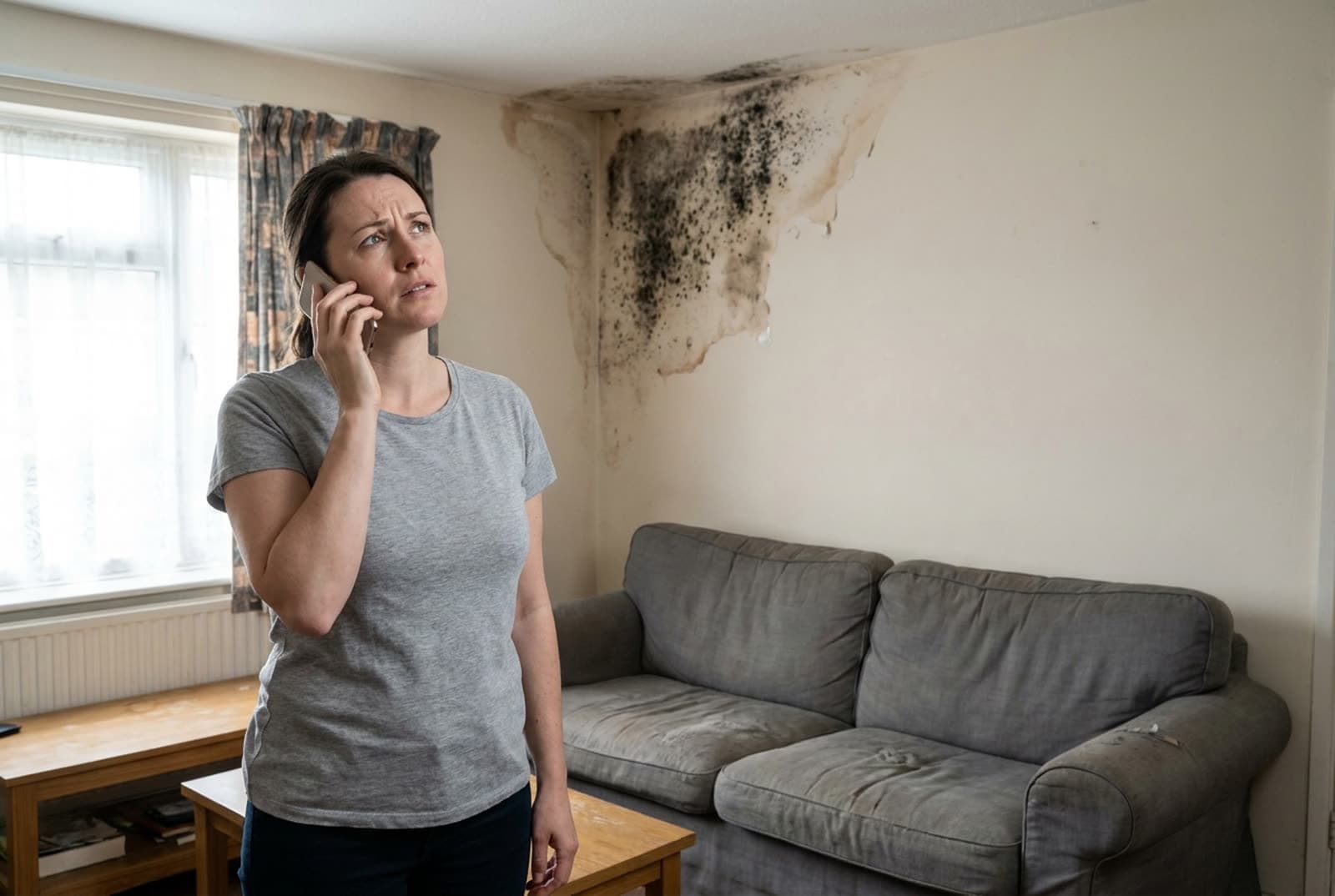
The exact steps to report damp in writing, what evidence to keep, and what your landlord must do under Awaab's Law. 5-minute read.
On this page
In short
Report damp in writing, by email or letter, not just a phone call. Describe each room affected. Attach dated photos. Ask for a written reply within 10 working days (the Awaab's Law deadline for a serious hazard). Keep a copy of everything you send. If you rent from a social landlord and the damp is a health risk, Awaab's Law gives them strict deadlines to act.
Key facts
- About 5% of homes in England, around 1.4 million, had a damp problem in 2024 to 2025. It is most common in privately rented homes, at 10%. English Housing Survey 2024-25, GOV.UK
- The same survey found about 9% of homes in England, around 2.3 million, had a category 1 (most serious) hazard under the HHSRS. In privately rented homes the figure was 10%. English Housing Survey 2024-25, GOV.UK
Step 1: Put it in writing
A phone call leaves no trail. Send an email to your landlord or housing officer with a clear subject line, such as "Damp and mould, Flat 4, 12 Example Road". In the message, list each room affected, when the problem started, and any health symptoms (a cough that gets worse at home, a child's asthma flaring up). Ask for a written reply and a date for an inspection.
If you do not have an email address, send a letter by recorded delivery and keep the proof of postage. Tenants who later need to take a claim further almost always wish they had started the paper trail sooner.
Step 2: Photograph and date everything
Take photos in daylight, with a newspaper or phone clock in the frame to prove the date. Take wide shots of each wall and close-ups of the worst patches. If mould comes back after you wipe it, photograph it again two weeks later. Our guide on what photos to take for a disrepair claim goes through this in detail.
Step 3: Know the deadlines
For social housing (council or housing association), Awaab's Law sets clear times. Once you report it:
- Emergency hazards: made safe within 24 hours.
- Serious damp and mould: looked into within 10 working days.
- A written summary of what they found: sent to you within 3 working days of that check.
- Work to make the home safe: completed within 5 working days of the check ending.
- Bigger follow-on jobs: started within 12 weeks.
Section 11 of the Landlord and Tenant Act 1985 also makes every landlord keep the structure and outside of the home in repair. That covers most causes of damp.
If your landlord misses these deadlines, ignores you, or sends someone who just paints over the mould, you may have a disrepair claim. Call Support for Tenants on 0800 030 4669 for a free, no-obligation eligibility check, or read how long a disrepair claim takes.
Free alternative: Citizens Advice can help you draft your first letter at no cost.
Sources
- Landlord and Tenant Act 1985, Section 11 (legislation.gov.uk)
- Awaab's Law: guidance for social landlords (GOV.UK)
- Understanding and addressing the health risks of damp and mould in the home (GOV.UK)
We review every guide at least twice a year and update it when the law changes. If you spot something out of date or wrong, email help@supportfortenants.co.uk.
Reviewed against current housing law for England and Wales as at 17 May 2026. Checked by our SRA-regulated panel solicitors. This is general information, not legal advice for your specific case. Any compensation figures or ranges shown are illustrative only, not a promise; every case is different.
Related guides
Can I sue my landlord for mould?
Yes. If your landlord ignores damp and mould, you can claim. Here is the law and how it works.
Read
Is condensation the landlord's fault or mine?
Often the landlord's. If condensation comes from poor ventilation, cold walls, or a building fault, it is their job to fix. Here is how to tell.
Read
How do damp and mould affect your health?
Damp and mould can cause breathing problems, chest infections, and worse asthma. They are a serious hazard and your landlord must act. Here is what to do.
Read
Still stuck?
Call us free or start a claim online. We'll tell you honestly whether you have a case worth pursuing.