
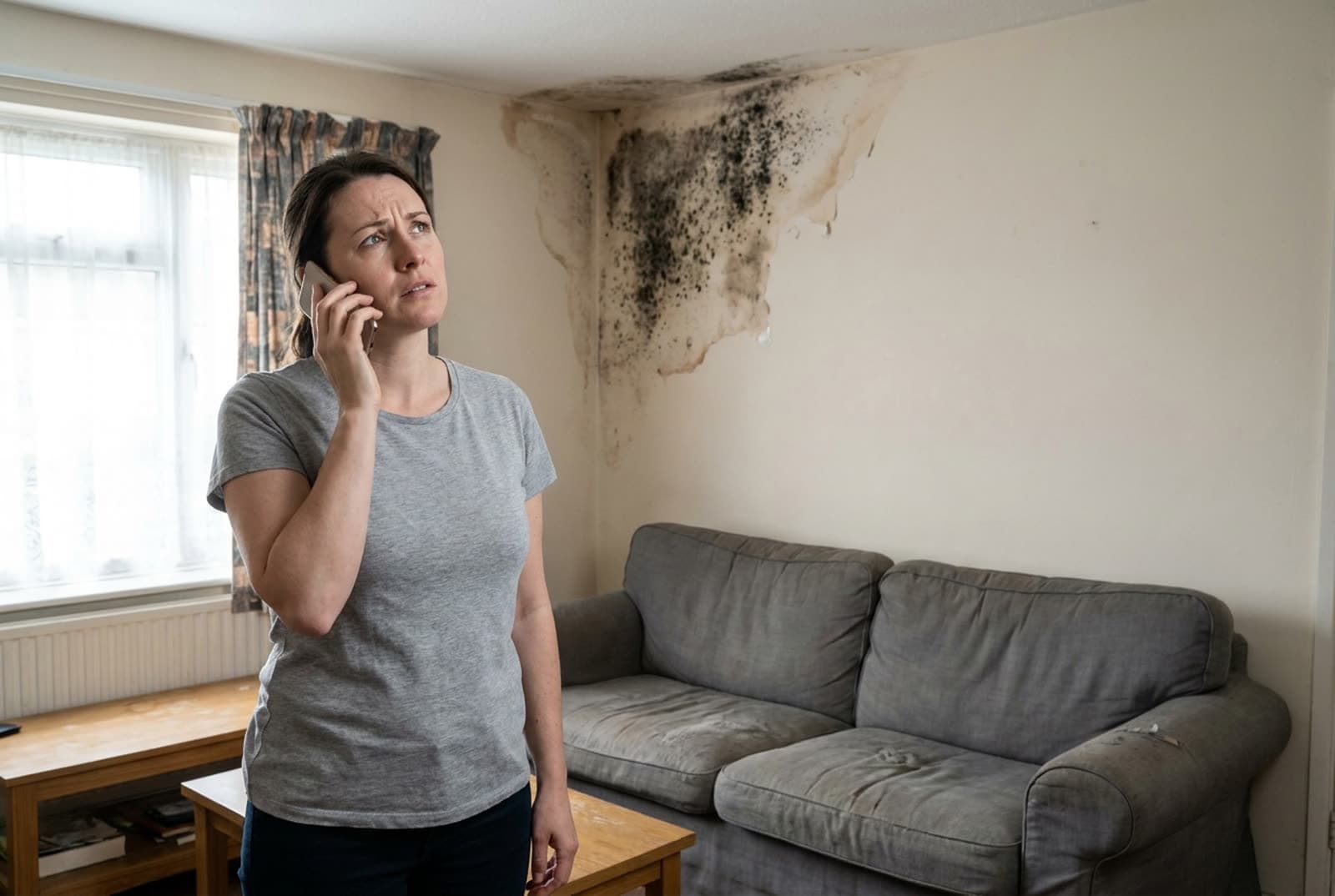
If you are dealing with damp and mould in a rented home in England or Wales, your landlord has a legal duty to fix it. Here is exactly what your rights are and what to do next.
On this page
Short answer: If you rent in England or Wales, your landlord has a legal duty to keep the home free from serious damp and mould. You have the right to report it and the right to a written response. Where the landlord has failed to act inside a reasonable time, you also have the right to claim compensation through a housing disrepair claim. You may have a claim, call us free on 0800 030 4669.
This is not a "courtesy" the landlord can ignore. It is law.
The legal basis
Three pieces of legislation matter most:
- Section 11 of the Landlord and Tenant Act 1985, applies to almost all short tenancies in England. The landlord must keep the structure and outside of the home in repair. They must also keep in working order the installations for water, gas, electricity, sanitation, space heating and water heating. Damp coming through the roof, walls, or windows is a structural repair issue. In Wales, the equivalent repair and fitness duties come from Part 4 of the Renting Homes (Wales) Act 2016.
- Homes (Fitness for Human Habitation) Act 2018, applies to almost all residential tenancies in England. The home must be fit for human habitation for the whole tenancy. Mould is listed as a hazard in its own right. If the home is not fit, the tenant can take the landlord to court.
- Awaab's Law (in force 27 October 2025), applies to social landlords in England. Where a damp or mould hazard could affect tenants' health or safety, the landlord must:
- For an emergency hazard, investigate and make the home safe within 24 hours
- For a significant hazard, investigate within 10 working days and complete the safety work within 5 working days of that investigation ending. A written summary must reach the tenant within 3 working days of the investigation
In Wales, the Renting Homes (Wales) Act 2016 does the same job. Every occupation contract includes a "fitness for human habitation" fundamental term. The Welsh fitness regulations list damp and mould among 23 prescribed hazards.
What "damp and mould" includes
Black mould on walls, ceilings or window reveals. Condensation that keeps coming back and never dries out. Penetrating damp from a failed roof, gutter, downpipe or wall. Rising damp from missing or breached damp-proof courses. Plaster bubbling or paint flaking from wet walls. Belongings going mouldy in cupboards or wardrobes. A musty smell that does not clear with airing.
If the landlord blames "lifestyle", too much washing, not enough ventilation, that defence is much weaker than it used to be. The courts and independent rulings have repeatedly held that the landlord must investigate before blaming the tenant.
What you must do
To trigger the landlord's duty, the landlord has to be on notice. That means you have to tell them, and you need to be able to prove you told them. The minimum:
- Report in writing. Portal, email or letter. Phone calls alone do not count.
- Describe what you see. Rooms affected, when it started, how severe.
- Send photographs, dated, with the room visible.
- Flag any health impact. Especially for children, older people, people with asthma, COPD, eczema, or anyone with a weakened immune system. A doctor's letter strengthens this hugely.
- Keep every reference and response.
Use our letter builder to produce a clean, dated complaint that starts the landlord's formal clock.
What the landlord has to do
- Investigate. Sending a contractor to look is the minimum. Not "wait and see".
- Fix the cause, not just the symptom. Wiping mould off and painting over it is not a repair. The cause has to be dealt with: a leak, a structural fault, a ventilation fault, or an insulation fault.
- Stay in touch. You should get a written response within the landlord's published complaints timescales.
- Move you if needed. If you truly cannot live in the home while repairs are done, the landlord should arrange somewhere temporary.
If the landlord ignores you
- Use the formal complaints procedure, Stage 1, then Stage 2.
- Consider a housing disrepair claim. Where the landlord has failed to act inside a reasonable time after being told, the court can order the repairs. You may also get compensation. Call us free on 0800 030 4669.
The limitation period for disrepair claims is 6 years.
Compensation
Awards usually combine three things. First, a share of the rent paid for the affected period (often 25 to 50%). Second, general damages for inconvenience, distress and health impact. Third, the cost of replacing damaged belongings.
There is no fixed amount: compensation is based on a share of the rent paid during the affected period (courts often award roughly 25% to 50% of the rent for a serious, ongoing problem, the approach in Wallace v Manchester City Council), with more where there is documented serious health impact or the failings have continued for years. See our full guide on how much compensation for damp and mould.
Get help
If you have damp or mould that your landlord has not fixed, call Support for Tenants on 0800 030 4669 for a free assessment. We are a regulated company, not a law firm. We connect tenants with solicitors who run housing disrepair cases on a no-win-no-fee basis.
Sources: Section 11, Landlord and Tenant Act 1985 (legislation.gov.uk); Homes (Fitness for Human Habitation) Act 2018 (legislation.gov.uk); Awaab's Law: guidance for social landlords, GOV.UK.
Support For Tenants is a trading name of Cyntex Group Ltd, authorised and regulated by the Financial Conduct Authority as a Claims Management Company. FRN 1020217. Registered in England and Wales.
Reviewed against current housing law for England and Wales as at 1 August 2026. Checked by our SRA-regulated panel solicitors. This is general information, not legal advice for your specific case. Any compensation figures or ranges shown are illustrative only, not a promise; every case is different.
Related on Support for Tenants
Renting with damp, mould or leaks your landlord won't fix?
No upfront cost. You only pay if you win, and the fee comes out of the compensation, not your pocket. If you don't win, you pay nothing.