
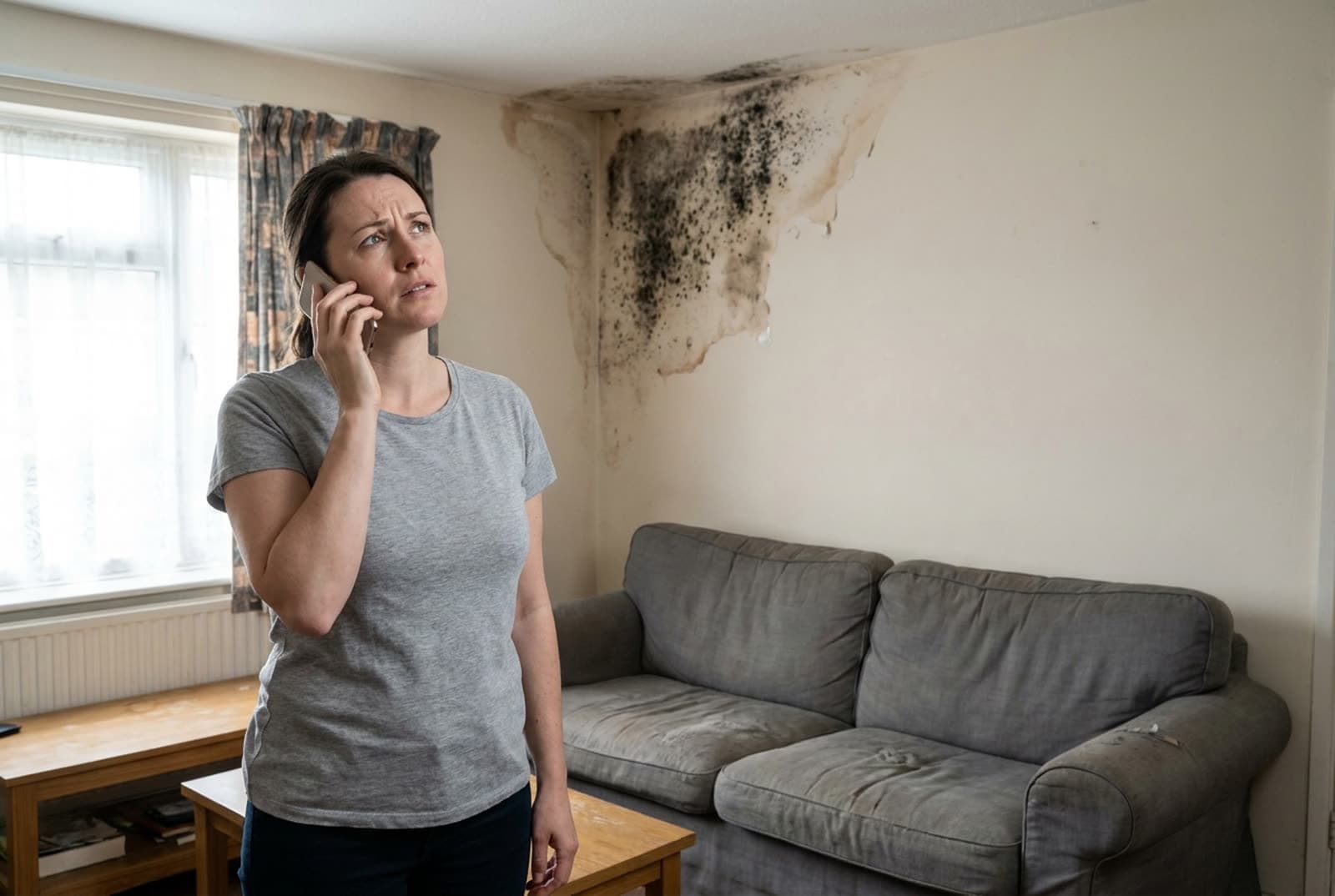
When you report damp to your landlord, they may say it is just "condensation" or a "lifestyle issue". They may say the damp is not their problem. Or they may
On this page
When you report damp to your landlord, they may say it is just "condensation" or a "lifestyle issue". They may say the damp is not their problem. Or they may agree it is penetrating damp but argue about where it comes from. Knowing the types of damp helps you push back with confidence.
Key facts
- The 2024 to 2025 English Housing Survey found serious condensation (3% of homes) was more common than penetrating damp (2%) or rising damp (1%). English Housing Survey 2024-25, GOV.UK
- The same survey found about 5% of homes in England, around 1.4 million, had a problem with damp, most common in privately rented homes (10%). English Housing Survey 2024-25, GOV.UK
The three main types of damp
1. Condensation damp
Condensation happens when warm, wet air touches a cold surface. This is usually outside walls, windows, or cold corners. Water droplets then form. In homes that are cold or have poor airflow, this can cause mould. The mould grows on walls, ceilings, around windows, and in wardrobes.
Landlords sometimes say all mould is condensation. They say it is your fault, from cooking, drying washing, or not letting in enough air. This is often wrong.
In a normal home used in a normal way, condensation mould is very often caused by problems with the building. These include poor insulation, cold spots in the walls, poor airflow, or not enough heating. Courts have rejected the "tenant's lifestyle" excuse again and again when the real cause was the building itself.
2. Penetrating damp
Penetrating damp happens when water gets in from outside. It comes through faults like a leaking roof, cracked outside walls, broken pointing, faulty gutters, blocked drains, or leaking window frames. It usually shows up as wet patches or stains on walls, often after rain. The wet patch is often right next to a fault on the outside wall.
Penetrating damp is nearly always the landlord's job to fix. It comes from a fault in the building that you cannot put right yourself. Section 11 of the Landlord and Tenant Act 1985 clearly puts "the structure and exterior of the dwelling" in the landlord's repair duty.
3. Rising damp
Rising damp happens when water from the ground rises up through the brickwork. This is usually because the damp-proof course is missing, has failed, or has been blocked by raised ground outside. It shows up as a tidemark low down on walls. You may also see salt marks and crumbling plaster.
Rising damp is less common than condensation or penetrating damp. It is also sometimes named wrongly. Like penetrating damp, it is a building fault and the landlord's job to fix.
How landlords use the condensation argument
When a landlord says "it's just condensation", they may be trying to dodge the repair. They make it sound like the problem is how you live. Here are some things they often say:
- "You need to open windows more often"
- "You should not dry washing indoors"
- "The mould is because you are cooking a lot"
- "If you heated the property more, you would not have this problem"
These points may be true in very extreme cases. But in a normal home with good insulation and airflow, they are often wrong. The real question is this: can the home be lived in normally without mould forming?
How to challenge the "it's condensation" argument
- Get your own damp survey. A RICS-qualified surveyor can find the type of damp, what is causing it, and whether the building is to blame. This is stronger evidence than a report from your landlord's own contractor.
- Write down the location and pattern. Penetrating damp shows up after rain and on outside walls. Rising damp shows up low down. Condensation shows up on cold surfaces in warm rooms. Photos with dates help show the pattern.
- Note the moisture readings. A damp meter reading from your own surveyor shows how much moisture is in the building materials, not just on the surface.
- Question the landlord's contractor in writing. Say your landlord sends someone who blames condensation but never checks the outside walls. Write back and ask them to explain. Ask why they have ruled out penetrating damp or rising damp, and what checks they did on the building.
- Ask for an HHSRS inspection. Environmental health will check the home under the Housing Health and Safety Rating System. Damp and mould is a Category 1 hazard when it puts your health at serious risk.
Why the type of damp matters in a claim
The type of damp decides who is to blame and how much the repair costs. If it is penetrating damp from a failing roof or cracked wall, the landlord must fix the outside of the building. Sometimes a landlord just keeps treating the surface mould over and over without fixing the real cause. That is a cover-up repair, not a proper one. Each time the mould comes back, it adds to the time the home was in disrepair. That time is used to work out your compensation.
When should I contact Support for Tenants?
If you have damp or mould that keeps coming back, call us on 0800 030 4669.
No upfront cost. You only pay if you win, and the fee comes out of the compensation, not your pocket. If you don't win, you pay nothing.
Sources
- Section 11, Landlord and Tenant Act 1985 (legislation.gov.uk)
- Housing Health and Safety Rating System (HHSRS) guidance (GOV.UK)
Related articles
- Is condensation the landlord's fault or mine?
- My landlord painted over the mould, is that a proper repair?
- Damp survey, who pays?
We review every guide at least twice a year and update it when the law changes. If you spot something out of date or wrong, email help@supportfortenants.co.uk.
Reviewed against current housing law for England and Wales as at 15 June 2026. Checked by our SRA-regulated panel solicitors. This is general information, not legal advice for your specific case. Any compensation figures or ranges shown are illustrative only, not a promise; every case is different.
Related guides
Can I sue my landlord for mould?
Yes. If your landlord ignores damp and mould, you can claim. Here is the law and how it works.
Read
How to report damp to your landlord (and make it stick)
The exact steps to report damp in writing, what evidence to keep, and what your landlord must do under Awaab's Law. 5-minute read.
Read
Is condensation the landlord's fault or mine?
Often the landlord's. If condensation comes from poor ventilation, cold walls, or a building fault, it is their job to fix. Here is how to tell.
Read
Still stuck?
Call us free or start a claim online. We'll tell you honestly whether you have a case worth pursuing.