
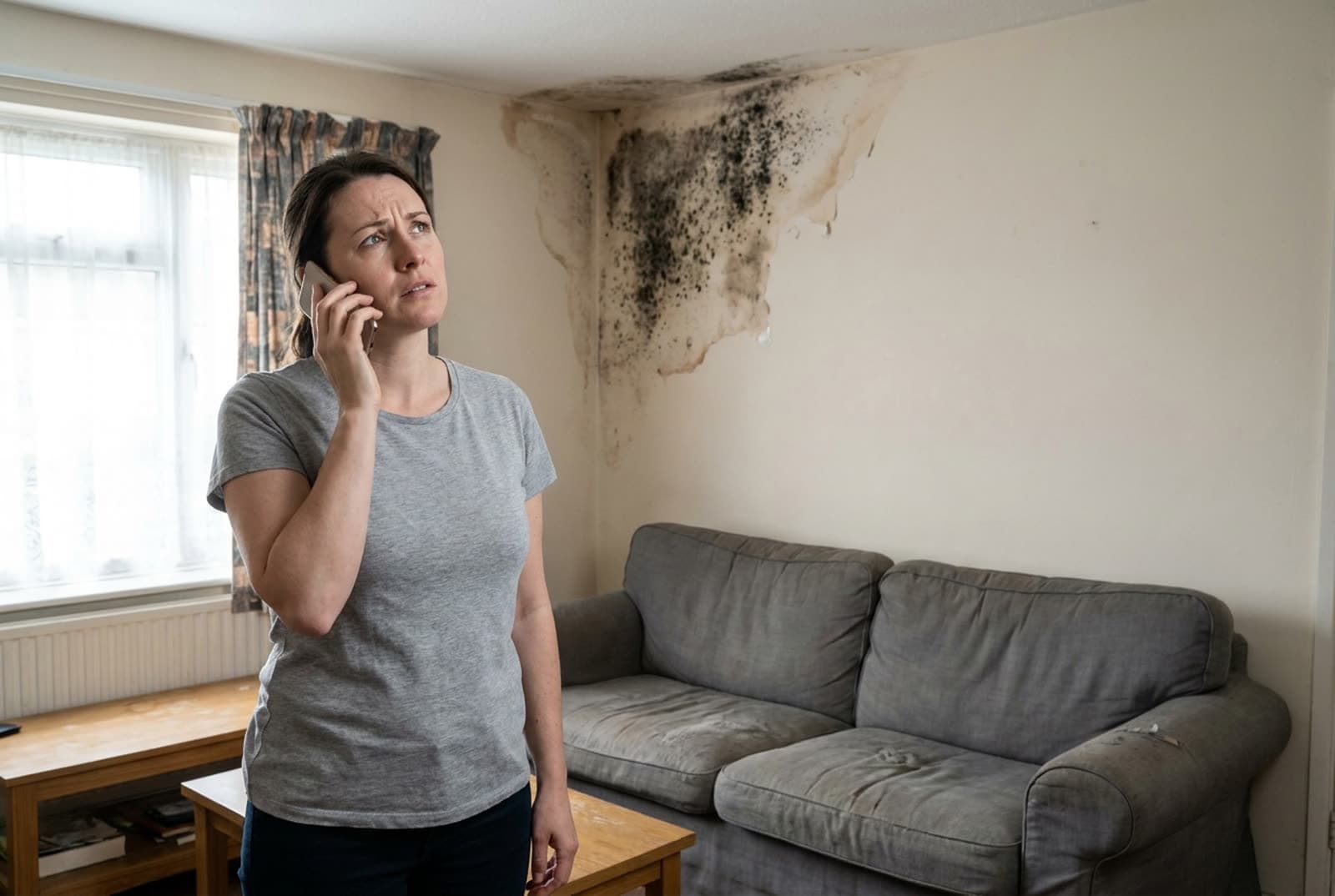
A damp survey is a check of your home by a trained professional. They find the type of damp, what is causing it, and how to fix it. It is strong proof for a
On this page
In short
A damp survey is a check of your home by a trained professional. They find the type of damp, what is causing it, and how to fix it. It is strong proof for a disrepair claim. It shows the problem is real and that it is the landlord's job to fix. In a claim with us, we arrange the check for you at no cost. You do not have to pay for one yourself up front.
Does your rented home have damp or mould? A professional damp survey can be a key piece of proof. Here we explain what a damp survey is, who does it, what it covers, and how it can help a housing disrepair claim.
Key facts
- The 2024 to 2025 English Housing Survey found about 5% of homes in England, around 1.4 million, had a problem with damp, most common in privately rented homes (10%). English Housing Survey 2024-25, GOV.UK
- Official guidance from the UK Health Security Agency and the Department of Health and Social Care links damp and mould in homes in England to around 5,000 cases of asthma and 8,500 lower respiratory infections among children and adults. Health risks of damp and mould, GOV.UK
What is a damp survey?
A damp survey is a check of your home by a trained professional. They find out if there is damp, what type it is, where it comes from, and how bad it is. There are a few different types of damp that can affect a home:
- Rising damp: water rising up through the walls from the ground. This usually happens when a damp-proof course has failed or was never there.
- Penetrating damp: water getting in through the outside walls, the roof, or around windows. It is caused by building problems such as damaged rendering, faulty gutters, or leaking roofs.
- Condensation: water forming on cold surfaces from warm, damp air inside the home. It can be linked to poor airflow or heating that is not good enough.
It matters to name the right type of damp. The type tells you who is to blame and what the fix should be. Penetrating damp and rising damp are nearly always the landlord's job. Condensation is harder to judge. It depends on the cause.
Who carries out a damp survey?
Damp surveys are usually done by:
- Chartered surveyors (RICS-qualified) who can write reports for use in court
- Damp and timber firms who give technical checks. But their reports may be seen as biased if they also sell treatments.
- Building surveyors who check the overall state of a home, including damp
In a housing disrepair claim, a surveyor asked by the solicitor will write a fair, independent report. You can use this report as proof. This is different from a survey paid for by a landlord or a damp treatment firm, which may have another aim.
What does a damp survey involve?
The surveyor will usually:
- Look closely at the areas with damp
- Use a moisture meter to measure how wet the walls, floors, and ceilings are
- Check the likely causes of the damp: faulty gutters, cracked rendering, blocked airflow, rising damp, leaks
- Take photos of the affected areas
- Write down what they find in a report
The report will usually include:
- A note of the damp found and where it is
- The moisture readings taken during the survey
- The surveyor's view on the likely cause
- Advice on how the damp should be fixed
How does a damp survey help your disrepair claim?
A professional survey report can:
- Show what the disrepair is and how bad it is
- Find the cause, which helps show whether it is the landlord's job to fix
- Give proof of when the problem started or how long it has been there
- Back up your account of problems you told the landlord about but they did not fix
Courts give a lot of weight to fair, independent professional proof. A well-prepared survey report is one of the strongest pieces of proof in a housing disrepair claim.
Should I commission my own survey?
Are you bringing a housing disrepair claim through a solicitor on a no win no fee basis? Then the solicitor will usually arrange for a surveyor to visit your home as part of the claim. You do not normally need to arrange your own survey.
If you are not yet in touch with a solicitor and want your own proof first, you could pay for your own survey before you report the problem to the landlord or the council. But please know this will usually cost several hundred pounds.
When should I contact Support for Tenants?
We arrange professional surveys as part of housing disrepair claims. If your home has damp or mould that your landlord has not fixed, call us.
Call us on 0800 030 4669. No upfront cost. You only pay if you win, and the fee comes out of the compensation, not your pocket. If you don't win, you pay nothing.
Sources
- Landlord and Tenant Act 1985, Section 11 (legislation.gov.uk)
- Homes (Fitness for Human Habitation) Act 2018 (legislation.gov.uk)
- Understanding and addressing the health risks of damp and mould in the home (GOV.UK)
Related articles
We review every guide at least twice a year and update it when the law changes. If you spot something out of date or wrong, email help@supportfortenants.co.uk.
Reviewed against current housing law for England and Wales as at 15 June 2026. Checked by our SRA-regulated panel solicitors. This is general information, not legal advice for your specific case. Any compensation figures or ranges shown are illustrative only, not a promise; every case is different.
Related guides
Can I sue my landlord for mould?
Yes. If your landlord ignores damp and mould, you can claim. Here is the law and how it works.
Read
How to report damp to your landlord (and make it stick)
The exact steps to report damp in writing, what evidence to keep, and what your landlord must do under Awaab's Law. 5-minute read.
Read
Is condensation the landlord's fault or mine?
Often the landlord's. If condensation comes from poor ventilation, cold walls, or a building fault, it is their job to fix. Here is how to tell.
Read
Still stuck?
Call us free or start a claim online. We'll tell you honestly whether you have a case worth pursuing.