Black mould can harm your health. Official guidance links damp and mould in England to thousands of cases of asthma and chest infections each year. The worst
On this page
In short
Black mould can harm your health. Official guidance links damp and mould in England to thousands of cases of asthma and chest infections each year. The worst cases can be dangerous. In a rented home, it is your landlord's job to fix black mould caused by disrepair. Report it in writing. Protect your health while you wait. See your doctor if you feel unwell.
Black mould (Stachybotrys chartarum and other species) is the type of mould people talk about most in homes. It is often linked to damp and poor airflow. Below, we look at the health risks linked to black mould. We also look at what you can do if it is in your rented home. Damp affects around 4% of households in England, according to the English Housing Survey. So this is a problem many tenants face.
Key facts
- Official guidance from the UK Health Security Agency and the Department of Health and Social Care links damp and mould in homes in England to around 5,000 cases of asthma and 8,500 lower respiratory infections among children and adults. Health risks of damp and mould, GOV.UK
- The same official guidance says that damp and mould in the home can make allergens, irritants, mould spores and other toxins that are harmful to health. Health risks of damp and mould, GOV.UK
What is black mould?
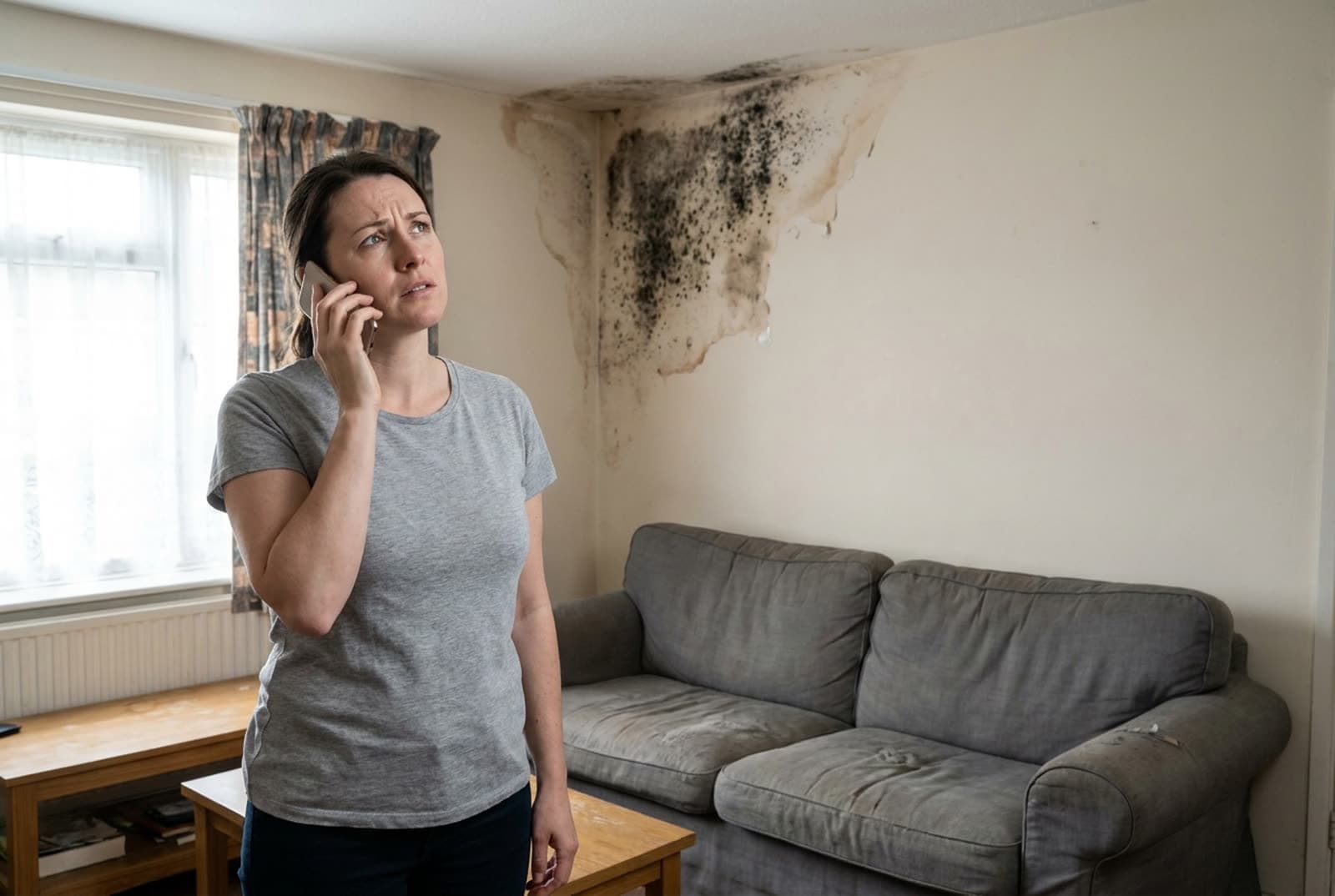
Black mould means several types of mould that look dark green or black. It usually grows on walls, ceilings, and around windows where there is moisture. This is often caused by condensation, damp coming in, or leaks. It grows well in warm, damp places. It can spread fast if the moisture problem is not dealt with.
Not all black mould is Stachybotrys. But you should take every type of mould in a home seriously.
What are the health risks?
Mould puts tiny spores and other bits into the air. Breathing these in can cause or worsen many health problems. These include:
- Breathing problems: coughing, wheezing, shortness of breath, and worse asthma or chronic obstructive pulmonary disease (COPD)
- Allergic reactions: sneezing, runny nose, red eyes, skin rashes
- Fungal infections: in people with a weak immune system, mould spores can cause more serious infections
- Upper respiratory infections: more so in children and older people
- Headaches and tiredness: some people get these in very mouldy homes
Children, older adults, people with asthma or other breathing problems, and people with a weak immune system are most at risk.
Government guidance does not play down the danger. It warns that "the respiratory effects of damp and mould can cause serious illness and, in the most severe cases, death". It names babies, children, older people, pregnant women, and those with breathing problems or a weak immune system as most at risk.
Is black mould in my home my landlord's fault?
It depends on the cause. Mould can come from:
- Problems with the building: if water gets in through a leaky roof, poorly kept gutters, rising damp, or failed rendering, it is your landlord's job to fix this under section 11 of the Landlord and Tenant Act 1985
- Poor airflow: if the home does not have good enough airflow, for example no extractor fan in the bathroom, or windows that cannot open properly, this may be your landlord's job
- Day-to-day living: lots of condensation from drying clothes indoors or cooking without good airflow can add to mould. But landlords cannot use this as an excuse to dodge fixing problems with the building
In real life, mould in a rented home often comes from both. If the building is sound and has good airflow, the normal amount of condensation a household makes should not cause big mould problems.
What should I do if I have black mould?
- Report it to your landlord in writing as soon as you find it. Include photos and the date.
- Say how bad it is and where it is. Note which rooms are affected and roughly how big an area.
- Note any health symptoms you or your family have that you think are linked to the mould.
- Ask your landlord to inspect it and find the cause, not just treat the mould you can see. Painting over mould or bleaching the surface without fixing the cause will not solve the problem for long.
If your landlord does not reply, contact the council's environmental health team.
Can I claim compensation for health problems caused by mould?
The mould may have been caused by a building problem your landlord was meant to fix. If you or someone in your household then had health problems because of it, you may have a housing disrepair claim. Medical evidence that links your health problems to the housing conditions can make your claim stronger.
When should I contact Support for Tenants?
Your rented home may have black mould that your landlord has not properly fixed. If it is affecting your health or the health of people in your household, call us to talk about a claim.
Call us on 0800 030 4669. No upfront cost. You only pay if you win, and the fee comes out of the compensation, not your pocket. If you don't win, you pay nothing.
Sources
- Understanding and addressing the health risks of damp and mould in the home (GOV.UK)
- Landlord and Tenant Act 1985, Section 11 (legislation.gov.uk)
- Homes (Fitness for Human Habitation) Act 2018 (legislation.gov.uk)
- English Housing Survey (GOV.UK)
Related articles
We review every guide at least twice a year and update it when the law changes. If you spot something out of date or wrong, email help@supportfortenants.co.uk.
Reviewed against current housing law for England and Wales as at 15 June 2026. Checked by our SRA-regulated panel solicitors. This is general information, not legal advice for your specific case. Any compensation figures or ranges shown are illustrative only, not a promise; every case is different.
Related guides
Can I sue my landlord for mould?
Yes. If your landlord ignores damp and mould, you can claim. Here is the law and how it works.
Read
How to report damp to your landlord (and make it stick)
The exact steps to report damp in writing, what evidence to keep, and what your landlord must do under Awaab's Law. 5-minute read.
Read
Is condensation the landlord's fault or mine?
Often the landlord's. If condensation comes from poor ventilation, cold walls, or a building fault, it is their job to fix. Here is how to tell.
Read
Still stuck?
Call us free or start a claim online. We'll tell you honestly whether you have a case worth pursuing.