
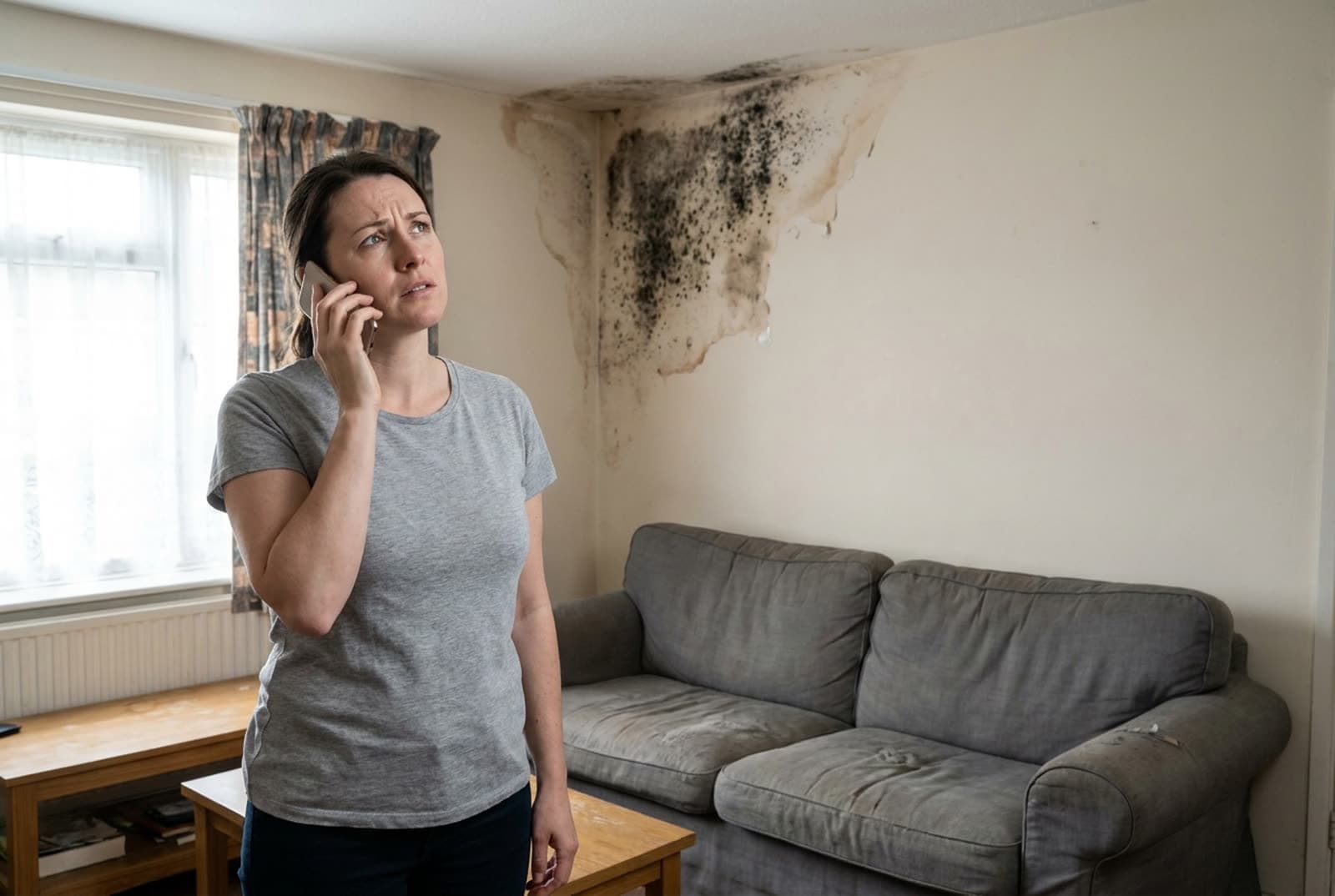
Once your landlord knows about the damp, the law says they must act. If they have not fixed it within a reasonable time, you can escalate to the council and,
On this page
The short answer
Once your landlord knows about the damp, the law says they must act. If they have not fixed it within a reasonable time, you can escalate to the council and, if that does not work, make a legal claim. The longer the delay, the longer the period for which compensation may be owed.
Key facts
- The 2024 to 2025 English Housing Survey found about 5% of homes in England, around 1.4 million, had a problem with damp, most common in privately rented homes (10%). English Housing Survey 2024-25, GOV.UK
- The Housing Ombudsman's 2021 report "Spotlight on damp and mould: it's not lifestyle" called on landlords to stop automatically blaming tenants' lifestyle for damp and mould. Housing Ombudsman, Spotlight on damp and mould
What the law says
Under Section 11 of the Landlord and Tenant Act 1985, landlords must keep the structure and exterior of a rented home in repair. This covers damp caused by leaking roofs, failed guttering, defective damp-proof courses, penetrating damp, and rising damp.
Knowledge is the legal trigger. Your landlord cannot be in breach until they know about the problem. From the moment they do know, the obligation to repair begins.
Three situations: and what each means for you
Your landlord admits the problem but gives no timeline. Ask them in writing for a specific repair date. A reasonable timeframe is usually two to four weeks for straightforward repairs, though structural damp may take longer. If no date comes, move to the next step.
A contractor came, sprayed bleach, painted over the patch, and the damp returned. Surface treatment is not a repair. If the underlying cause was not fixed, the breach has continued. Date your photographs carefully each time the problem comes back.
Your landlord says it is condensation and blames the way you live. This is the most common deflection. If the cause is structural: rising damp, penetrating damp, or a leaking roof, your behaviour as a tenant is not relevant. An independent inspection will show whether the problem is structural or not.
Escalation: three steps in order
Step 1: Formal written complaint. Write to your landlord by email or letter. State when you first reported the problem, what has (or has not) been done, and give them a final deadline to repair it. Keep a copy.
Step 2: Ask your council to inspect. Environmental health officers can visit your home and assess it under the Housing Health and Safety Rating System (HHSRS). If the damp poses a risk to health, they can issue an Improvement Notice that legally forces the landlord to carry out repairs. This is free to request.
Step 3: Make a civil disrepair claim. If the landlord still does nothing, you can claim compensation for the time you lived in a substandard home, plus the cost of repairs. No upfront cost. You only pay if you win, and the fee comes out of the compensation, not your pocket. If you don't win, you pay nothing.
If you are a social tenant (council or housing association)
You must work through the landlord's internal complaints procedure first: Stage 1, then Stage 2. Once you have a final response, or eight weeks have passed without one, you can take the case to the Housing Ombudsman. The Ombudsman can order repairs and award compensation.
Keep a record of everything
Take dated photographs as often as you can. Keep a short diary noting when symptoms appear, which rooms are affected, and what the weather is like. Damp that worsens after rain tends to point to structural causes. Save every text, email, or letter you have sent and received. This record is what makes a complaint into a winning claim.
When should I contact Support for Tenants?
Call us on 0800 030 4669 if your landlord has known about the damp for more than four weeks and has not fixed it, if a repair was done but the problem has come back, if your landlord is blaming you for the damp and you are not sure where you stand, or if you want help writing a formal complaint or requesting a council inspection.
No upfront cost. You only pay if you win, and the fee comes out of the compensation, not your pocket. If you don't win, you pay nothing.
Sources
- Landlord and Tenant Act 1985, Section 11 (legislation.gov.uk)
- Homes (Fitness for Human Habitation) Act 2018 (legislation.gov.uk)
- Awaab's Law: guidance for social landlords (GOV.UK)
- Understanding and addressing the health risks of damp and mould in the home (GOV.UK)
Related articles
- How to make a formal complaint to your landlord
- How to request an HHSRS inspection
- How to report damp to your landlord
We review every guide at least twice a year and update it when the law changes. If you spot something out of date or wrong, email help@supportfortenants.co.uk.
Reviewed against current housing law for England and Wales as at 15 June 2026. Checked by our SRA-regulated panel solicitors. This is general information, not legal advice for your specific case. Any compensation figures or ranges shown are illustrative only, not a promise; every case is different.
Related guides
Can I sue my landlord for mould?
Yes. If your landlord ignores damp and mould, you can claim. Here is the law and how it works.
Read
How to report damp to your landlord (and make it stick)
The exact steps to report damp in writing, what evidence to keep, and what your landlord must do under Awaab's Law. 5-minute read.
Read
Is condensation the landlord's fault or mine?
Often the landlord's. If condensation comes from poor ventilation, cold walls, or a building fault, it is their job to fix. Here is how to tell.
Read
Still stuck?
Call us free or start a claim online. We'll tell you honestly whether you have a case worth pursuing.