
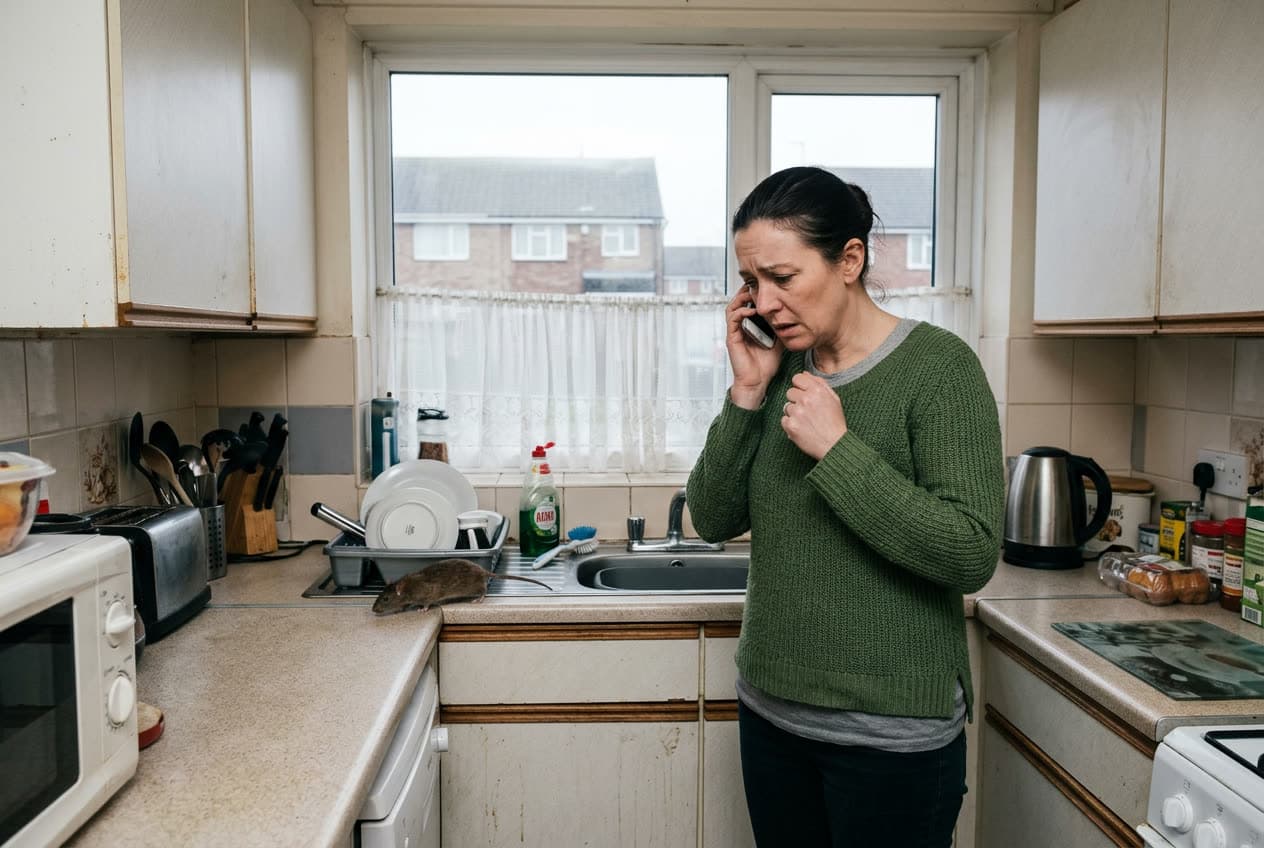
If there are rats in your rented home, your landlord usually has a legal duty to deal with the cause and the infestation. Here is how the law works and what to do step by step.
On this page
Short answer: If you rent in England or Wales and you have a rat infestation, your landlord usually has a legal duty to deal with it, both the rats and the structural defect that let them in. Rats are explicitly listed as a hazard under the Housing Health and Safety Rating System (HHSRS) and the Welsh fitness regulations. Where a landlord refuses to act, you can report it to environmental health and, where the landlord has left the problem unfixed, you may have a claim for compensation, call us free on 0800 030 4669.
The exception is where the infestation has been clearly caused by the tenant, for example, ongoing food waste left out, and there is no structural entry point. Even then, the landlord usually owns the structural side.
The legal basis
- Section 11 of the Landlord and Tenant Act 1985. The landlord must keep the structure and exterior of the dwelling in repair. Holes in walls, gaps under floorboards, broken air bricks, broken drain covers, missing roof tiles, gaps around pipes, all classic rat entry points, are structural issues.
- Homes (Fitness for Human Habitation) Act 2018. In England, the home must be fit for human habitation throughout the tenancy. The HHSRS lists "domestic hygiene, pests and refuse" as a Category 1 or 2 hazard. Significant rat infestation in the home fails the fitness test.
- Renting Homes (Wales) Act 2016. In Wales, the fitness for human habitation fundamental term and the 23 hazards in the Welsh fitness regulations include pests.
- Environmental Protection Act 1990. Local authority environmental health teams can serve abatement notices on landlords where the property is a statutory nuisance.
What is "the landlord's responsibility" versus "the tenant's responsibility"
The general rule:
| Cause | Usually landlord | Usually tenant |
|---|---|---|
| Holes in the structure | Yes | , |
| Gaps around pipes, air bricks, drains | Yes | , |
| Communal areas of a block | Yes (block landlord) | , |
| Shared garden, fly-tipping at boundary | Yes (block landlord/council) | , |
| Pest treatment to clear an active infestation | Usually yes (especially social landlords) | , |
| Hygiene inside the home, bins managed properly | , | Yes |
Most social landlords (councils, housing associations) include pest control inside the home as part of their service offer. Private landlords vary, your tenancy agreement may specify.
What you must do
- Report it in writing immediately. Portal, email or letter, keep the reference.
- Describe what you have seen. "I saw two rats in the kitchen on [date]. Droppings along the skirting board. Suspected entry point under the boiler pipework."
- Send photographs and short videos, dated.
- Flag vulnerability. Children, older people, anyone immunosuppressed, rats carry Weil's disease (leptospirosis) and salmonella; the public-health risk is real.
- Keep food, surfaces and bins as clean as you reasonably can. This blocks the landlord's first defence (blaming you) and protects you.
- Keep all receipts if you have had to buy traps, hire pest control privately, or replace contaminated food and belongings.
Use our letter builder for a clean, dated formal complaint that starts the landlord's complaints timescale.
What the landlord has to do
- Investigate the cause. Sending pest control to put down bait without fixing the entry point is not a permanent repair, the rats will be back.
- Carry out pest treatment. Usually through their own contractor or the council's pest team.
- Repair the structural defect. Block the hole. Fix the air brick. Replace the drain cover. Seal around the pipe.
- Communicate. You should get a written response inside the landlord's published complaints timescales.
What you do if the landlord ignores you
- Use the formal complaints procedure, Stage 1, then Stage 2.
- Contact your local authority environmental health team. They can inspect, score the hazard under HHSRS, and serve an improvement notice on the landlord. This is free.
- Document the impact, receipts for everything you have had to throw away or replace, doctor visits, time off work, sleep disruption.
- Consider a housing disrepair claim if the landlord has failed to act inside a reasonable time after being told. You may have a claim, call us free on 0800 030 4669.
Compensation
Rat infestation cases are settled on similar principles to other disrepair claims, a percentage of rent paid during the affected period, general damages for distress and inconvenience, and the cost of replacing contaminated belongings. There is no fixed amount: the longer the infestation lasted and the worse its impact, the higher the award tends to be. The limitation period is six years.
Get help
If you have a rat infestation and your landlord is not dealing with it, call Support for Tenants on 0800 030 4669 for a free assessment. We are a regulated company, not a law firm, we work with solicitors who run housing disrepair cases on a no-win-no-fee basis.
Free alternative: Contact your local council's environmental health team, they can serve notices on the landlord at no cost to you.
Sources: Section 11, Landlord and Tenant Act 1985 (legislation.gov.uk); Environmental Protection Act 1990, Section 82 (legislation.gov.uk).
Support For Tenants is a trading name of Cyntex Group Ltd, authorised and regulated by the Financial Conduct Authority as a Claims Management Company. FRN 1020217. Registered in England and Wales.
Reviewed against current housing law for England and Wales as at 1 August 2026. Checked by our SRA-regulated panel solicitors. This is general information, not legal advice for your specific case. Any compensation figures or ranges shown are illustrative only, not a promise; every case is different.
Related on Support for Tenants
Renting with damp, mould or leaks your landlord won't fix?
No upfront cost. You only pay if you win, and the fee comes out of the compensation, not your pocket. If you don't win, you pay nothing.