
Pre-1939 terraces account for a disproportionate share of damp-related disrepair claims. Here is what surveyors check, why the construction makes it worse, and what counts as evidence.
On this page
In short
Pre-1939 terraced houses (Victorian, Edwardian and inter-war) produce far more than their share of damp claims in England. The way they were built is the reason: solid 9-inch external walls, slate damp-proof courses that have failed with age, lime-mortar joints, and suspended timber ground floors with air bricks that are often blocked. All of it makes damp easier to start and harder to fix.
When a surveyor inspects, they look for a specific set of visible, measurable signs. Know what they look for, and you know what to photograph and what to ask the landlord about.
Why pre-1939 stock is more prone to damp
Three features of pre-1939 building work make these homes more open to damp than later stock.
1. Solid 9-inch external walls (no cavity). Cavity walls became common after 1920 and standard after 1945. Before that, terraces usually had solid external walls one brick thick (around 9 inches, or 220mm). A solid wall has no insulating air gap. In winter the inside surface runs cold, and that is exactly where condensation forms.
2. Damp-proof courses that have failed or were never installed. Damp-proof courses (DPCs) were not required by law until 1875, and not universal until the 1930s. Older terraces either have no DPC, or a slate one that has failed with age. Without a working DPC, ground moisture climbs into the lower wall. The result is rising damp, visible as a tide mark up to about 1 metre from the floor.
3. Lime-mortar pointing that erodes. Pre-1900 walls were pointed in lime mortar, which is softer than modern cement. Over a century, weather wears the pointing back and opens tiny cracks that let driving rain into the wall. Penetrating damp from worn pointing shows up most on the windward side of Victorian terraces.
These problems feed each other. A pre-1939 terrace with a failed DPC, worn pointing, blocked air bricks under a timber floor, and weak heating will have damp that no amount of "open the windows" will fix.
The surveyor's checklist
When a chartered surveyor inspects a pre-1939 terrace for disrepair, they usually work through this list. Photograph these features before the surveyor arrives, and you often shortcut the report.
External, looking up at the building:
- Condition of roof: missing tiles, slipped slates, dipped ridge, chimney pointing
- Gutters and downpipes: blocked, leaking, displaced. Look for staining on the wall below
- External wall condition: cracked rendering, blown render, eroded pointing
- Window frames: rotten timber, broken seals, condensation between panes
- Air bricks at low level: present, unblocked, clear of soil or debris
- DPC line: visible as a slate or asphalt course just above ground level. Tide marks above this line indicate DPC failure
- Boundary walls and ground level: has soil or paving been built up above the DPC level, bridging it
Internal, ground floor:
- Tide marks on internal walls up to about 1m from the floor (rising damp signature)
- Crystalline salt deposits at low level (hygroscopic salts pulled up by rising damp)
- Skirting boards: rotten, soft, separating from the wall
- Underfloor void: reached through a hatch or a lifted board. The surveyor checks moisture readings and looks for standing water
- Suspended timber floor condition: bouncy, springing, signs of woodworm or rot
Internal, upper floors:
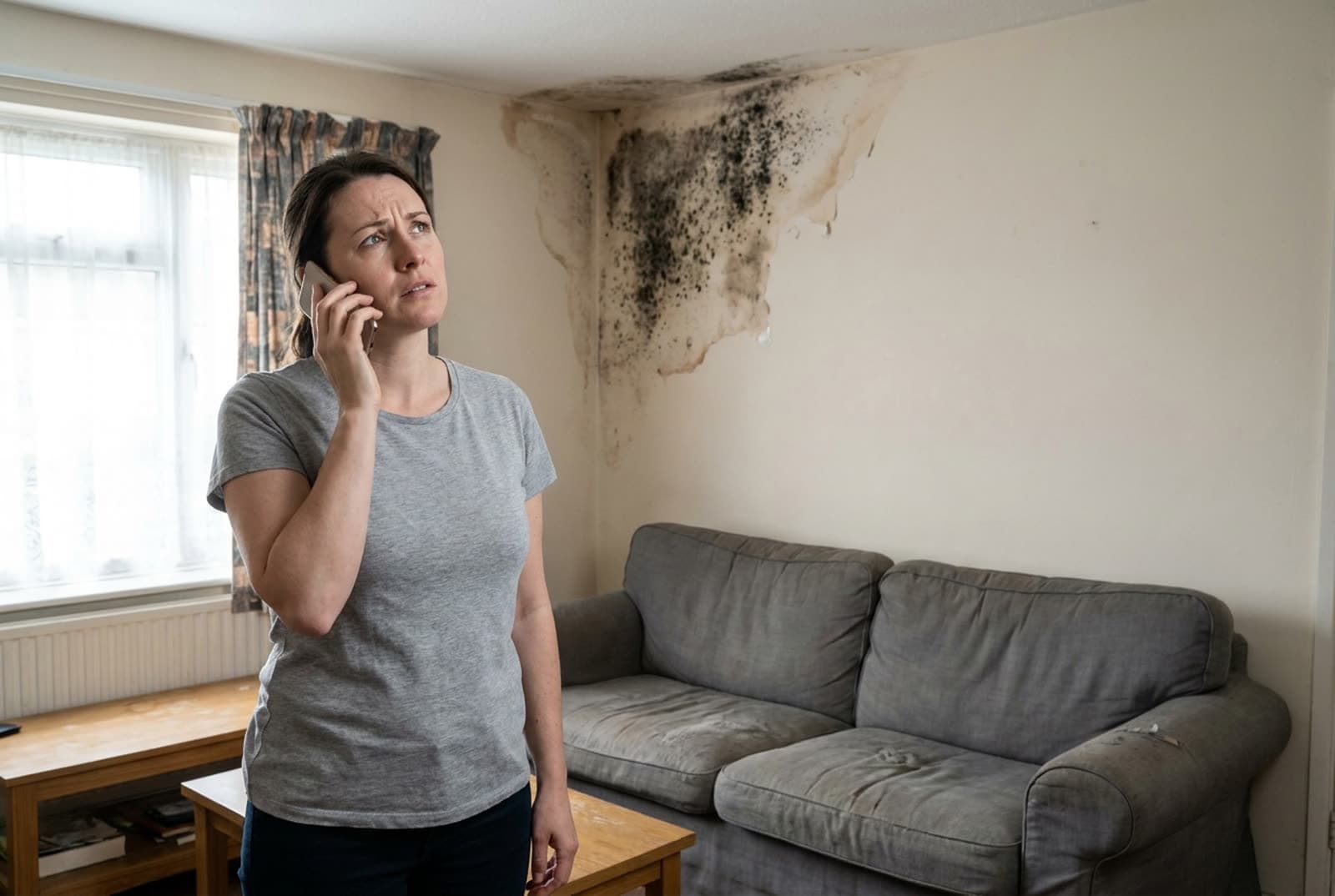
- Black mould patterns in corners and behind furniture (cold-spot condensation)
- Tide marks running diagonally across ceilings (penetrating damp from roof or upper external wall)
- Mould around windows (cold bridging at the lintel)
- Bathroom and kitchen extractor fans: present, ducted properly to outside, working
Heating and ventilation:
- Boiler age and service history
- Radiator size in each room (a too-small radiator under a cold window is a common defect)
- Trickle vents on windows: present and open
- Internal humidity readings (a hygrometer reading consistently above 70% is a red flag)
What landlords often get wrong
Three mistakes come up again and again in pre-1939 disrepair cases.
1. Treating mould as a ventilation problem when it is rising damp. A common landlord response is "open the windows more". For true rising damp, ventilation makes no difference. The surveyor's DPC-line check is what tells the two apart. Tide marks up to about 1m from the floor, plus high moisture readings low on the wall, mean the cause is the wall, not your behaviour.
2. Replastering without addressing the source. Stripping damp-stained plaster and replastering is a cosmetic fix only. If the source (a failed DPC, blocked air bricks, worn pointing, a leaking gutter) is not dealt with, the new plaster fails within 12 to 24 months. A surveyor's report should always name both the symptom (damp wall) and the cause (a specific structural defect).
3. Charging the tenant for "tenant-caused" damp. Damp in pre-1939 stock with the features above is almost always a structural problem. Attempts to charge tenants for it, through recharges, deposit deductions or eviction threats, can usually be challenged.
What to photograph this week
Live in a pre-1939 terrace and suspect damp? These are the photographs that matter most:
- The wall affected, with a ruler or hand visible for scale
- The DPC line, the slate or asphalt course just above ground level outside your front and back walls
- Air bricks at low level (front and back), close-up
- Soil or paving level relative to the DPC line, side-on view
- Gutters and downpipes from the street
- Window frames and surrounding wall condition
- Inside the kitchen and bathroom, the extractor-fan exit grilles outside the building
- A hygrometer reading in each affected room (a basic hygrometer costs less than £10)
Your phone dates each photo automatically. Take new ones every two months to build a record over time.
Where Support for Tenants fits
Pre-1939 terrace damp claims are the most common disrepair case we see. The evidence they need is exactly what a tenant can prepare in advance. If your landlord keeps saying the damp is your fault, and your home has the features above, the surveyor's report will usually say otherwise. We refer to a panel solicitor on no-win-no-fee terms.
How to report damp to your landlord | Free call: 0800 030 4669
Sources: Section 11, Landlord and Tenant Act 1985 (legislation.gov.uk).
Support For Tenants is a trading name of Cyntex Group Ltd, authorised and regulated by the Financial Conduct Authority as a Claims Management Company. FRN 1020217. Registered in England and Wales.
Reviewed against current housing law for England and Wales as at 19 May 2026. Checked by our SRA-regulated panel solicitors. This is general information, not legal advice for your specific case. Any compensation figures or ranges shown are illustrative only, not a promise; every case is different.
Related on Support for Tenants
Renting with damp, mould or leaks your landlord won't fix?
No upfront cost. You only pay if you win, and the fee comes out of the compensation, not your pocket. If you don't win, you pay nothing.