
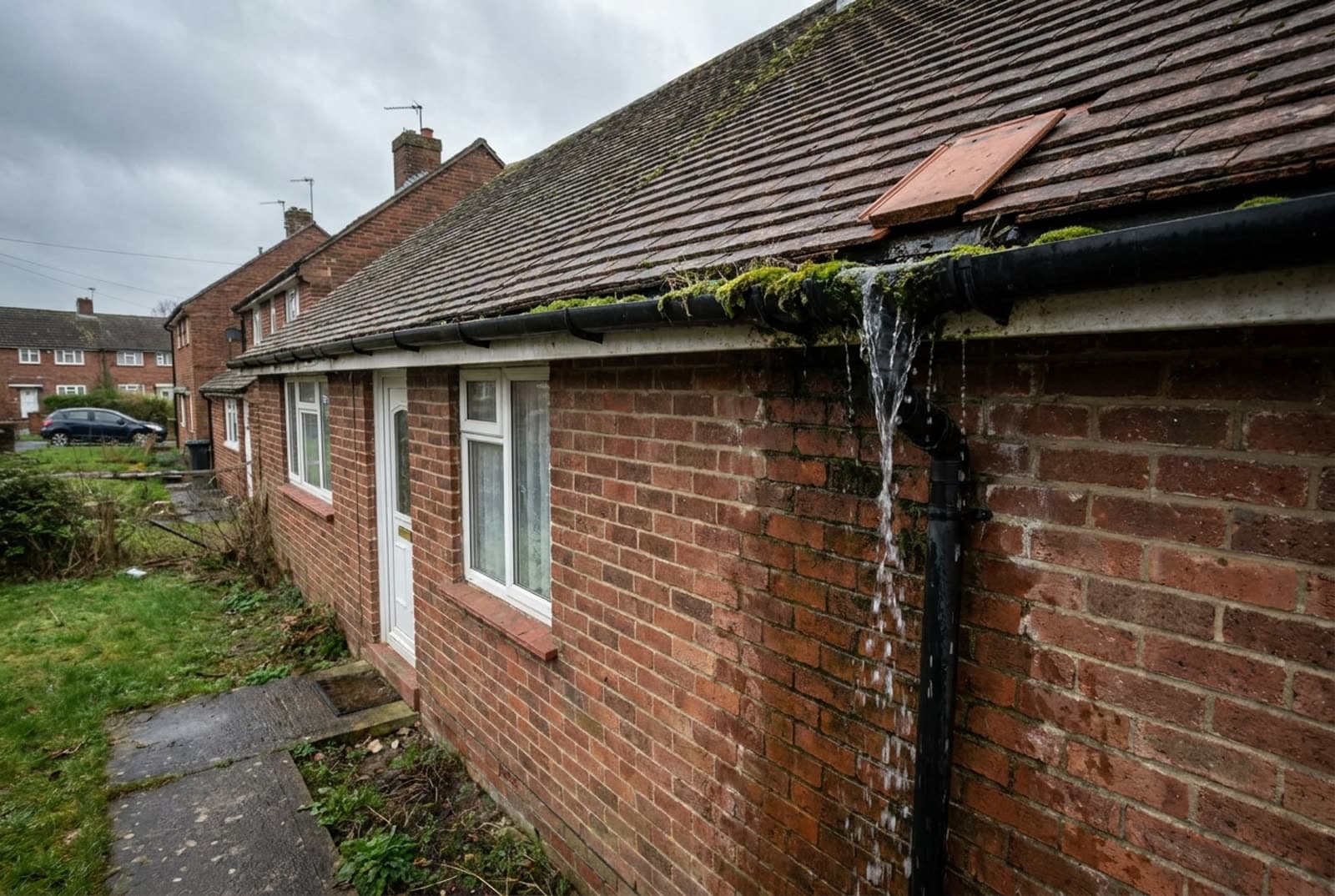
A leaking roof can wreck your home and your belongings. Water through the ceiling brings damp, mould, ruined plaster and furniture, and electrical risks.
On this page
A leaking roof can wreck your home and your belongings. Water through the ceiling brings damp, mould, ruined plaster and furniture, and electrical risks. Here is who must fix it, what to do if they will not, and when you may have a claim.
Key facts
- The 2024 to 2025 English Housing Survey found about 5% of homes in England, around 1.4 million, had a problem with damp, most common in privately rented homes (10%). English Housing Survey 2024-25, GOV.UK
- The same survey found about 9% of homes in England, around 2.3 million, had a category 1 (most serious) hazard under the HHSRS. In the private rented sector the figure was 10%. English Housing Survey 2024-25, GOV.UK
Is the landlord responsible for the roof?
Yes. Under Section 11 of the Landlord and Tenant Act 1985, your landlord must keep the structure and outside of the home in repair. The roof is part of both. This covers most private and social rented homes in England.
That means your landlord must repair:
- Broken, cracked or missing tiles
- Failed flashings: the metal strips around chimneys, dormer windows, and where roof meets wall
- Blocked or broken gutters and downpipes pushing water into the roof space
- Damaged covering on a flat roof
- Damage to the roof timbers from water getting in
The duty holds in houses and flats alike. In a flat, whoever runs the building answers for the roof, even if you live lower down and the water passes through another flat to reach you.
What about flats: whose roof is it?
In a block the roof is usually shared. Whoever owns or manages the building answers for it: the freeholder, or a management company. A landlord who is a leaseholder usually has to push them for you.
A long leak nobody acted on may still ground a claim, even where the roof is not directly your landlord's, as long as your landlord had the means to force the repair.
How do I report a roof leak?
Report it to your landlord in writing as soon as you spot it. Include:
- Where the water comes in: which room, which part of the ceiling or wall
- When you first noticed it
- Whether it is getting worse
- Any damage to your belongings or the home
Photograph the staining, the wet plaster, the mould, and any damaged belongings. Keep every message and letter you send.
What if the landlord does not fix it?
The landlord must fix the roof within a fair time of being told. What counts as fair depends on how bad it is. Water pouring in demands urgent action. A slow drip on a dry day allows a little longer.
Ignored, fobbed off, or given a patch job that dodges the real problem? You can:
- Tell the council's environmental health team. It can inspect and serve improvement notices
- Bring a disrepair claim for the damage, the inconvenience and any health effects
- Ask the court yourself for an order making the landlord repair (take legal advice first)
Can I claim compensation?
If the leak ruined belongings, harmed health, or shut off part of your home, you may be able to claim. A successful claim can cover:
- Damage to furniture, clothes and other belongings
- Higher heating bills, where the leak made the home hard to keep warm
- The inconvenience and the hit to daily life
- Health harm, above all where damp or mould from the leak made someone ill
When should I contact Support for Tenants?
Reported a roof leak in writing, and still no fix? You may have a housing disrepair claim.
Call us on 0800 030 4669. No upfront cost. You only pay if you win, and the fee comes out of the compensation, not your pocket. If you don't win, you pay nothing.
Sources
- Landlord and Tenant Act 1985, Section 11 (legislation.gov.uk)
- Homes (Fitness for Human Habitation) Act 2018 (legislation.gov.uk)
Related articles
We review every guide at least twice a year and update it when the law changes. If you spot something out of date or wrong, email help@supportfortenants.co.uk.
Reviewed against current housing law for England and Wales as at 15 June 2026. Checked by our SRA-regulated panel solicitors. This is general information, not legal advice for your specific case. Any compensation figures or ranges shown are illustrative only, not a promise; every case is different.
Related guides
Burst pipe: who is responsible, the landlord or tenant?
A burst pipe is your landlord's job to repair. It is an emergency. Here is the law, who pays for the damage, and what to do right now.
Read
Is my landlord responsible for a broken toilet?
Yes. Your landlord must fix a broken toilet. If it is the only toilet in the home, it is an emergency. Here is the law and what to do.
Read
Is my landlord responsible for broken windows?
Yes, your landlord must repair broken windows. A window that will not close is a security and cold-weather risk. Here is the law and what to do.
Read
Still stuck?
Call us free or start a claim online. We'll tell you honestly whether you have a case worth pursuing.