
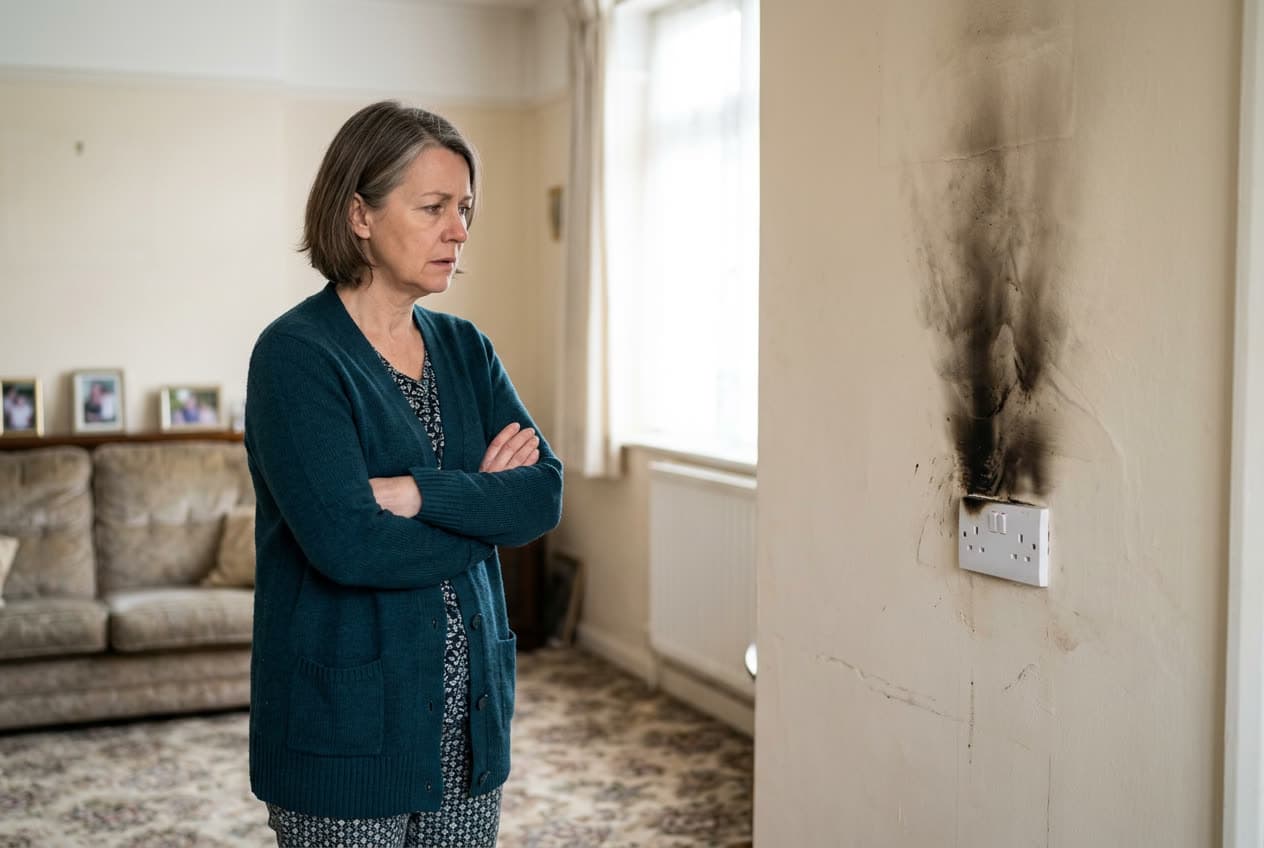
Small electric shocks from a socket or switch are a serious warning sign. Stop using it, report it as an emergency. Here is what your landlord must do.
On this page
In short
Any kind of shock from a socket, switch or appliance, even a tiny tingle, is a real safety warning. It usually means the earth is faulty, the wiring is breaking down, or there is moisture inside the wall. Stop using that socket. Treat it as an emergency. Report it to your landlord today, and if they will not act, call the council's environmental health team or, if there is a real risk, the fire service. Call us free on 0800 030 4669.
Why even a small shock matters
Modern wiring is designed so you should never feel a thing. A small shock means the protective parts of the circuit are not working properly. The same fault can become a much larger shock the next time, or start a fire inside the wall. There is no safe level. Do not "wait and see."
Common causes:
- Damaged or perished cable insulation.
- Water inside the wall reaching a live wire.
- A loose earth connection in the socket or consumer unit.
- A faulty appliance feeding back into the circuit.
- DIY work that did not meet wiring regulations.
What to do right now
- Unplug everything from that socket. Do not use the switch again until checked.
- If there is a smell of burning, switch the affected circuit off at the consumer unit.
- Stop touching metal taps if you have felt a shock from a tap.
- Note exactly what you were doing, the date and time.
- Take photos of any visible damage, scorch marks or melted plastic.
- Report it to your landlord's emergency line and put it in writing.
Your landlord's duty
Several laws apply at once. This is one of the strongest duty areas in housing law.
- Section 11 of the Landlord and Tenant Act 1985, electrical installations and wiring.
- The Electrical Safety Standards in the Private Rented Sector (England) Regulations 2020, private landlords must have a valid EICR (Electrical Installation Condition Report) every 5 years.
- The Homes (Fitness for Human Habitation) Act 2018, the home must be fit to live in throughout the tenancy.
- The Landlord and Tenant Act 1985 s.4(1), common-law duty of care for foreseeable injury.
- Awaab's Law for social tenants, severe electrical hazards must be made safe within 24 hours.
See electrical safety and your landlord's duties and EICR, electrical safety certificate, tenant rights.
What the landlord must send
Not a handyman. The person who attends must be either:
- A NICEIC- or NAPIT-registered electrician.
- Or someone working under a registered electrician's supervision.
They must check the circuit, identify the cause, and either repair or isolate the fault that day. A proper repair includes a follow-up EICR if the wiring is old.
If the landlord delays
This is one of the few areas where you do not wait. If your landlord is slow:
- Call your council's environmental health team and say "live electrical hazard."
- If there is a real and immediate risk (burning smell, smoke, repeated shocks), call 999 and the fire service.
- Send a formal complaint in writing, see how to write a complaint letter.
- Ask for an HHSRS inspection, see how to request an HHSRS inspection.
Your health and your case
Even a small shock can affect the heart in people with existing conditions. Anyone in the home who has felt a shock should be seen by their doctor or NHS 111. Keep a record of every visit. See health evidence in a disrepair claim and personal injury from disrepair for the legal side.
How we can help
If your landlord has not arranged a qualified electrician within 24 hours, or there has been an actual injury, call us free on 0800 030 4669. Electrical hazards are some of the strongest disrepair claims because the duty is so clear.
Free call: 0800 030 4669 | Start your claim
Sources
- Electrical Safety Standards in the Private Rented Sector (England) Regulations 2020 (legislation.gov.uk)
- Landlord and Tenant Act 1985, Section 11 (legislation.gov.uk)
- Homes (Fitness for Human Habitation) Act 2018 (legislation.gov.uk)
- Awaab's Law: guidance for social landlords (GOV.UK)
We review every guide at least twice a year and update it when the law changes. If you spot something out of date or wrong, email help@supportfortenants.co.uk.
Reviewed against current housing law for England and Wales as at 28 May 2026. Checked by our SRA-regulated panel solicitors. This is general information, not legal advice for your specific case. Any compensation figures or ranges shown are illustrative only, not a promise; every case is different.
Related guides
Burst pipe: who is responsible, the landlord or tenant?
A burst pipe is your landlord's job to repair. It is an emergency. Here is the law, who pays for the damage, and what to do right now.
Read
Is my landlord responsible for a broken toilet?
Yes. Your landlord must fix a broken toilet. If it is the only toilet in the home, it is an emergency. Here is the law and what to do.
Read
Is my landlord responsible for broken windows?
Yes, your landlord must repair broken windows. A window that will not close is a security and cold-weather risk. Here is the law and what to do.
Read
Still stuck?
Call us free or start a claim online. We'll tell you honestly whether you have a case worth pursuing.